


Community guide · La Quinta
The Quarry at La Quinta homes for sale: a buyer’s guide.
Quick answer
The Quarry at La Quinta is a private, member owned golf club and residential community set between Coral Mountain and the Santa Rosas, built on a former sand and gravel quarry. It was established in 1994 by two golfers looking for an alternative to crowded courses and unavailable tee times, and that origin still defines it: members are not required to book tee times, and the community is planned for only around 100 homes at full buildout. The Tom Fazio championship course runs through three distinct elevations, and the clubhouse is built into the original quarry wall. Real estate ownership is not required for membership. Of all the private communities in La Quinta, this is the most golf first and the smallest.
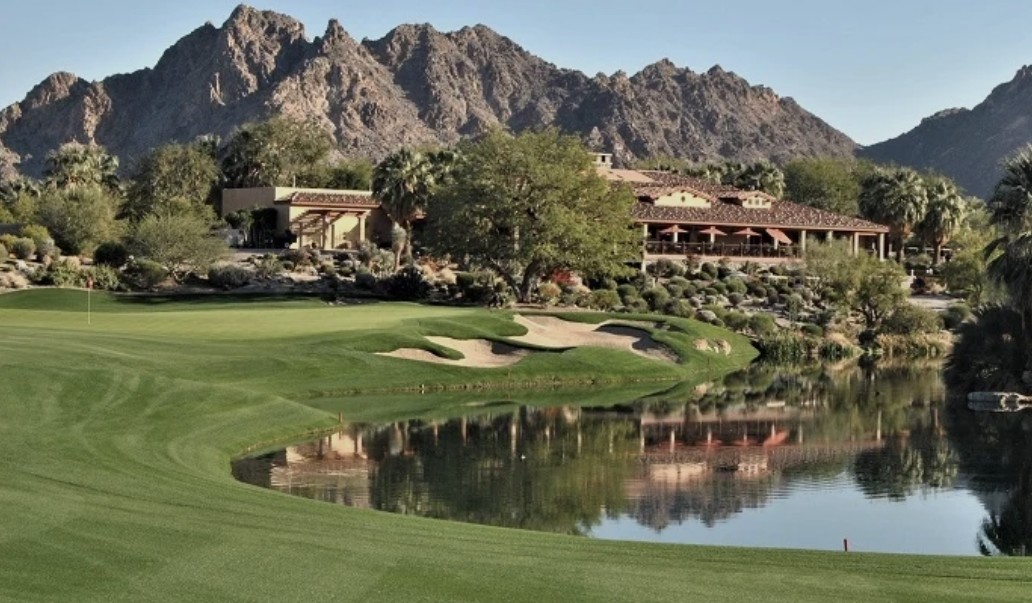
The Quarry at a glance
| Location | One Quarry Lane, La Quinta, between Coral Mountain and the Santa Rosa Mountains |
| Community type | Private, member owned equity golf club |
| Established | 1994; home building began 1997 |
| Origins | A former sand and gravel pit, known locally as the Keller pit |
| Golf | 18 hole Tom Fazio championship course, 10 hole Fazio short course and an 18 hole putting course |
| Course character | Three distinct elevations across more than 400 feet of elevation change, creating three separate playing areas |
| Tee times | Not required for members |
| Residences at buildout | Approximately 100 |
| Homesites | Commonly one half acre to one acre |
| Home sizes | Broadly 4,000 to 10,000+ sq ft |
| Architecture | Contemporary custom estates and ranch villas, designed to sit within the landscape |
| Clubhouse | Approximately 21,000 sq ft, built into the original quarry wall |
| Membership | Real estate ownership not required |
| Quarry Ranch | Added 2002; 74 acres, 29 homesites and the short course |
What makes The Quarry different
Most private clubs in the Valley were conceived as real estate developments with golf attached. The Quarry was conceived as a golf club with a small amount of real estate around it, and the difference shows in almost every decision the club has made since.
Two golfers started it because they were tired of crowded courses and unavailable tee times. They bought a 105 acre former gravel pit, acquired 255 adjacent acres, and built it out with thirteen founding associates. The no tee time policy that still runs today is not a marketing amenity. It is the reason the place exists.
The scale follows from the same logic. Around 100 homes at full buildout is a fraction of what the other private communities carry, and it is the single most important fact about The Quarry as a market. Inventory is genuinely scarce rather than seasonally tight.
The quarry itself is the other defining feature. Rather than flatten the site, Fazio routed the course through three distinct elevations, and the clubhouse was built into the original quarry wall to look back over the course. An abandoned western mine and a series of bronze sculptures sit within the landscape, and the guest cottages are named after Frederic Remington works. That western theme is unusual for the Valley and it is carried through consistently rather than applied as decoration.
Architecture, homesites and orientation
Homes here are contemporary custom estates and ranch villas rather than the hacienda and Mediterranean styles that dominate Tradition, and they were designed to sit within the landscape rather than on top of it. Homesites commonly run half an acre to a full acre.
Because the site has real topography, the same principles that govern value at Tradition apply here with more force. Elevation determines whether a property looks across a fairway, out over the course, or beyond it to the Valley and city lights. South and southwest aspects give the strongest mountain presentation and evening light at the cost of afternoon sun. Proximity to the clubhouse trades convenience against separation.
The positions worth understanding
At The Quarry, elevation is not a marketing adjective. The course moves through three distinct levels and more than 400 feet of elevation change, and the residential experience changes with it. Some homes sit close to the quarry floor and the golf. Others rise above the course far enough to see across the Valley to distant mountains and city lights.
The clearest elevated corridor is Banfield Drive, particularly the upper positions around the fourth hole. Homesites there combine something difficult to reproduce elsewhere in the community: the golf course below, the Santa Rosa Mountains in one direction, and the down valley horizon and city lights in another. That is a materially different proposition from conventional golf frontage. The course becomes part of a much larger landscape rather than the entire view.
Tom Fazio Lane offers another premium setting for a different reason. Select positions here combine golf immediately below the house with unusually deep sightlines beyond it: a double fairway running toward the Santa Rosas, or a south facing corridor across two holes with no residences interrupting it. One estate on the south side has been marketed around a 180 degree panorama taking in the course, the La Quinta city lights, the Chocolate Mountains and the Santa Rosas.
Those examples illustrate the point that matters most here. The strongest homesites tend to layer views rather than offer only one. Golf alone is valuable. Mountains alone are valuable. The rarer positions hold golf, elevation, mountains and a long down valley view in the same frame.
Quarry Ranch is a different product
Quarry Ranch was not part of the original residential plan. The club acquired an additional 74 acres in 2002 and created 29 residential sites together with Fazio’s short course, so its appeal differs from the original homesites around the championship course.
Properties along Quarry Ranch Road tend to emphasize space, privacy and mountain exposure, and some positions have little or no residential development immediately in front of or behind them.
Neither section is automatically superior. They solve different problems. A buyer prioritizing championship course frontage and dramatic elevation is usually drawn toward Banfield or the strongest Tom Fazio Lane positions. A buyer prioritizing space, separation and a more residential setting often prefers Quarry Ranch.
Perimeter versus interior
The perimeter positions offer something interior golf course homes cannot: a view that extends beyond the community itself. That is where city lights become relevant. From the higher eastern and down valley facing positions, the view continues past the course to the Valley floor and the distant mountains. After dark the golf largely disappears and the lights become the view.
Interior homesites generally give a more contained experience. The course, the rock walls and the surrounding mountains fill the frame, which can feel more private and immersive even when the absolute view distance is shorter.
There is no reliable public evidence that city light views universally command a greater premium than golf frontage, and we would not claim it. The more defensible conclusion is that the premium comes from the quality and scarcity of the complete view corridor. A beautifully oriented golf front home with mountains and no house across the fairway may be more desirable than an elevated property with city lights and a compromised foreground. A Banfield position that captures golf below, mountains, Valley and city lights commands attention precisely because it does not force that choice.
The three settings to understand before buying
Before comparing individual houses, it is worth seeing three different parts of The Quarry. Upper Banfield Drive demonstrates what elevation does here: golf below, long Valley views, city lights after dark. Tom Fazio Lane demonstrates the best version of golf frontage, particularly where a double fairway or an uninterrupted corridor creates unusual depth. Quarry Ranch Road demonstrates the later product, where privacy, space and mountain exposure can matter as much as direct championship course frontage.
Once a buyer has seen those three, the listings begin to make considerably more sense.
At The Quarry the most expensive view is not necessarily the one closest to the golf course.
It is usually the one that lets the eye keep going: across golf, beyond the community, and into the mountains or the Valley behind.
Membership
The Quarry is a member owned equity club and does not require real estate ownership in order to join. That is the same structure as Tradition and the opposite of the residence based model at The Madison Club and The Hideaway, and it matters in both directions. You are not obliged to buy a home to become a member, and buying a home does not carry membership with it.
Members and their guests who do not own here can stay in the club’s guest cottages, each named after a Remington sculpture and sitting a short walk from the clubhouse.
Membership is described as by invitation and the club does not publish a fee schedule publicly. Third party figures circulate and vary widely, which is a good reason not to rely on them. Confirm current availability, requirements, initiation and dues directly with the club as part of due diligence.
Current market snapshot
As of July 31, 2026, for the MLS subdivision The Quarry within La Quinta Area 313:
| Active listings | 1, asking $3,750,000 |
| Closed sales, six months | 4 |
| Closed price range | $1,601,000 to $6,000,000 |
| Median closed price | $4,362,500 |
| Closed price per sq ft | $476 to $1,173, median $872 |
| Closed home sizes | 3,361 to 8,346 sq ft |
| Closed homesites | 0.33 to 1.10 acres |
| Median sale to list ratio | 95% |
| Median days on market | 64 |
Four sales in six months against a single active listing is exactly what a hundred home community produces. Any one transaction moves the averages, and a buyer waiting for a particular position may wait a season or more.
Vintage matters more here than anywhere else in La Quinta
The spread in price per square foot across four sales was two and a half to one, from $476 to $1,173. That is by far the widest range of any private community in La Quinta, and it lines up almost perfectly with the year each home was built.
| Built 2000 | $476 per sq ft · 74 days · 87% of asking |
| Built 2001 | $719 per sq ft · 149 days · 95% of asking |
| Built 2021 | $1,173 per sq ft · 25 days · 98% of asking |
| Built 2026 | $1,025 per sq ft · 54 days · 95% of asking |
Read across that table rather than down it. The newer homes did not simply achieve a higher price per foot. They sold considerably faster and closer to asking. The two earliest homes took two to five times as long and gave up more on price.
The market here is bifurcated. Newer and comprehensively renovated homes move quickly and hold their asking price. Original condition homes from the first phase of building take time and negotiate. That pattern matters more at The Quarry than elsewhere because the community began building in 1997, so a meaningful share of the housing stock is now approaching thirty years old on a site where land values have moved a long way.
The single active listing reinforces the point. It has been marketed for 223 days and has come from an original asking price of $5,900,000 to $3,750,000, a reduction of 36 percent. One listing is not a trend, but combined with the pattern in the closed sales it says something useful: scarcity does not protect a mispriced home here.
Where the recent activity has been
Every home that traded in the period, and the one currently listed, sits on Tom Fazio Lane. In a community this size that is not surprising, but it should not be read as a description of the whole. Banfield Drive carries some of the most elevated positions here, and Quarry Ranch Road is a later and quite different collection. Recent transaction data simply has not touched them.
Source: GPS MLS and CRMLS, subdivision The Quarry, La Quinta Area 313, retrieved July 31, 2026. Closed sales cover January 31 to July 31, 2026. Information is deemed reliable but is not guaranteed. Updated monthly.
Who The Quarry is right for
The Quarry suits buyers for whom golf is the point rather than one amenity among several. The no tee time policy, the small membership and the Fazio course are the product, and the community around them is deliberately modest in scale.
It also suits buyers who want genuine seclusion. This is one of the quietest addresses in the Valley, well south of the busier corridors, and the small number of homes means it stays that way.
It is less suited to buyers who want an extensive social and family programme, or who want the range of dining, racquet and wellness facilities that a larger club can support. Those buyers are usually happier at The Hideaway or Andalusia.
How The Quarry compares
| The Quarry | The Madison Club | Tradition Golf Club | |
|---|---|---|---|
| Ownership | Member owned equity club | Discovery Land Company | Member owned equity club |
| Residences | Approximately 100 at buildout | Custom estates, villas and clubhouse suites | Custom estates and cottages |
| Golf | 18 holes plus a 10 hole short course, Tom Fazio | One 18 hole course, Tom Fazio | 18 hole championship plus 9 hole par 3, Arnold Palmer |
| Tee times | Not required | [X] | [X] |
| Ownership required for membership | No | Residence based club model | No |
| Price range | Recent closed sales $1.6M to $6M, median $4.36M | Approximately $12M to $85M | Recent closed sales $4.5M to $7.675M |
| Best suited to | Buyers for whom golf is the point and scale is not | Buyers prioritizing maximum privacy, service and trophy real estate | Buyers drawn to an intimate club culture and a strong sense of history |
Read the full guides: The Madison Club · The Hideaway · Tradition Golf Club · PGA WEST · Andalusia · all community guides
Frequently asked questions
Do you have to own a home at The Quarry to be a member?
No. The Quarry does not require real estate ownership in order to join, which distinguishes it from the residence based club model used at The Madison Club and The Hideaway. Members and their guests who do not own here can stay in the club's guest cottages. Membership is described as by invitation, and current availability, requirements and fees should be confirmed directly with the club.
How many homes are there?
Very few by Valley standards. The community is planned for approximately 100 residences at full buildout, making it the smallest of La Quinta's major private golf communities. For comparison, The Hideaway has 434 and PGA WEST has more than 5,000.
What is the history of the site?
The land was a working sand and gravel pit, known locally as the Keller pit, before it was a golf club. Two golfers looking for an alternative to crowded courses and unavailable tee times bought the 105 acre property, acquired an adjacent 255 acres, and developed it with a group of founding associates. The club was established in 1994 and home building began in 1997. In 2002 a further 74 acres were added as Quarry Ranch, bringing 29 additional homesites and the Tom Fazio designed 10 hole short course.
Are tee times required?
No. The club operates a no tee time policy for members, which is one of the most distinctive things about it and was part of the founders' original intent. In practical terms it means you can decide to play twenty minutes before you do.
What golf is there?
An 18 hole Tom Fazio championship course, a Tom Fazio designed 10 hole short course that can play as par 3s or short par 4s, and an 18 hole putting course. The championship course runs through three distinct elevations that create three separate playing areas, and it has been recognized on national top 100 rankings.
What do homes cost at The Quarry?
As of July 31, 2026 there was a single active listing, asking $3,750,000. Over the six months to July 31, 2026, four homes closed between $1,601,000 and $6,000,000, with a median closed price of $4,362,500 and a median of $872 per square foot. The median sale closed at 95 percent of asking after 64 days. Price per square foot is a poor guide on its own at The Quarry, because the spread across those four sales ran from $476 to $1,173, a factor of two and a half. That range tracks the age and condition of the home almost exactly. Newer and comprehensively renovated homes sold faster and closer to asking; original condition homes from the earliest phase of building took considerably longer and negotiated harder. With roughly 100 residences at buildout, inventory is genuinely scarce, but scarcity has not protected mispriced homes.
Are short term rentals allowed at The Quarry?
Generally, buyers should not assume a home at The Quarry can be used as a short term vacation rental. The City of La Quinta has prohibited most new short term vacation rental permits in non exempt residential areas since 2021, and The Quarry does not appear on the City’s current list of exempt developments, which includes areas such as Legacy Villas, La Quinta Resort, Puerta Azul and Signature at PGA WEST. There is one potentially relevant exception. Since January 2024 the City has allowed owners of qualifying parcels of 25,000 square feet or more to apply for a Large Lot Qualified and Certified exemption. Approval is not automatic: the property must meet the City’s criteria, and the exemption is considered by the City Council at a public hearing before the owner can apply for a new permit. That provision is worth investigating here because some Quarry estate homesites exceed 25,000 square feet. Lot size alone, however, does not create rental rights. The community’s own governing documents must also be reviewed. Current Quarry listings disclose rental restrictions, and at least one recent property was specifically marketed as not permitting short term rentals, so City eligibility should never be taken as confirmation that the association permits the use. For a buyer considering The Quarry partly for rental income, the correct due diligence is property specific: confirm the parcel size and permit eligibility with the City of La Quinta, then review the current Quarry CC&Rs and association rules before relying on any short term rental income. Full detail on the City ordinance, the exempt developments and the two exemption routes is on our page covering short term rental eligibility in La Quinta.
How does The Quarry compare to The Madison Club?
Both are small and highly private, but they are built on different principles. Madison is a Discovery Land Company community organized around service and a residence based club model, with a considerably higher price band. The Quarry is member owned, does not require ownership to join, runs no tee times, and is smaller still at roughly 100 homes. Madison is the more curated experience. The Quarry is the more golf first one.
Buying or selling here
Laurie McLennan has spent decades advising buyers and sellers throughout La Quinta and the Coachella Valley, including clients evaluating the desert’s most private golf and residential communities. Three generations of Realtors sit behind that experience, and a desert connection dating to 1960.
Last updated: July 31, 2026
Written by Laurie McLennan, Founder, The McLennan Team at Desert Sotheby’s International Realty
California DRE #01424382 · Board of Regents, Who’s Who in Luxury Real Estate