


Community guide · Palm Desert
BIGHORN Golf Club: a buyer’s guide.
Quick answer
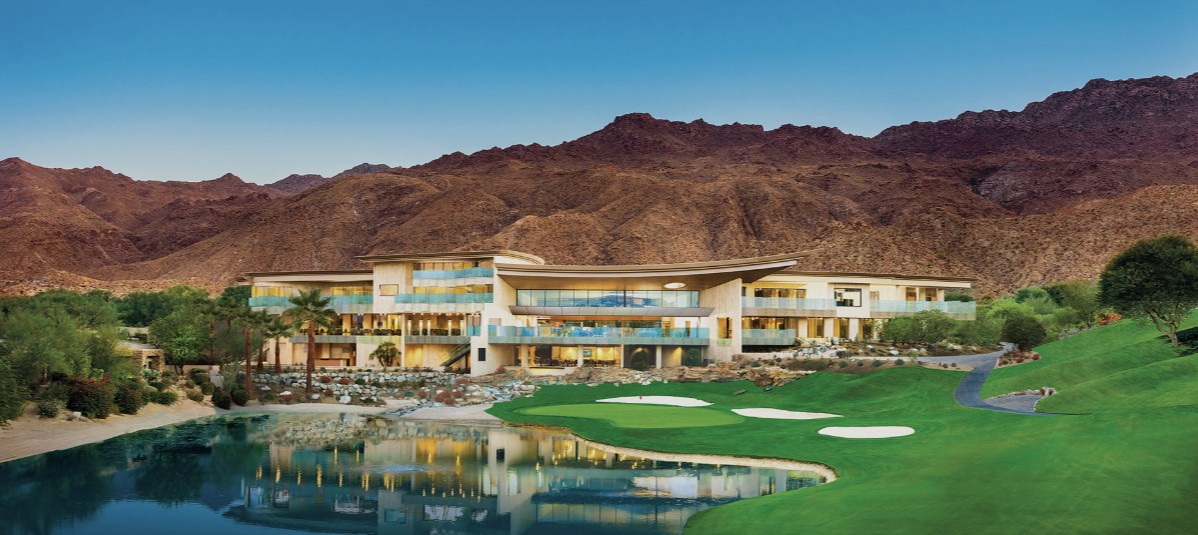
BIGHORN Golf Club sits in the Santa Rosa foothills above Palm Desert, three miles up Highway 74 from El Paseo, which gives it elevation and proximity to shopping and dining that few Valley clubs combine. Established in 1991, it holds two courses, the Mountains by Arthur Hills and the Canyons by Tom Fazio, linked by a cart tunnel beneath the highway, alongside an 80,000 square foot clubhouse and The Vault, an auto gallery where around ninety members display collections. Membership is restricted to property owners and is described as non equity, non voting and non transferable, which is a materially different structure from most Valley clubs. It also carries the highest median price per square foot of any community we track.
BIGHORN at a glance
| Location | 255 Palowet Drive, Palm Desert, in the Santa Rosa foothills three miles up Highway 74 from El Paseo |
| Community type | Private golf and residential community |
| Established | 1991 |
| Residences | Approximately 570 at completion, on fee simple land |
| Mountains course | Arthur Hills, opened 1991. 6,874 yards, rating 73.6, slope 143 |
| Canyons course | Tom Fazio, opened 1998. 7,043 yards, rating 74.8, slope 141 |
| Connection | A cart tunnel beneath Highway 74 links the two courses |
| Clubhouse | Approximately 80,000 sq ft |
| The Vault | An auto gallery where around 90 members display and store collections |
| Membership | Property owners only. Described as non equity, non voting and non transferable licences* |
| Home sizes | Recent sales from 3,314 to 10,525 sq ft |
| Homesites | Recent sales from approximately 0.29 to 0.83 acres |
| Recent closed sales | $2,975,000 to $14,500,000, median $5,700,000, six months to August 4, 2026* |
*Membership terms are set by the club and subject to change. Closed sale figures cover February 4 to August 4, 2026 and are a snapshot rather than a valuation guide.
What makes BIGHORN different
The elevation. BIGHORN climbs the Santa Rosa foothills rather than sitting on the valley floor, which changes both the golf and the views. Homes here look down across the Valley rather than out along a fairway, and the temperature differential at height is noticeable in the shoulder months.
Two courses by two very different architects. Arthur Hills routed the Mountains course in 1991 with a slope of 143, the highest of any course in the communities we cover. Fazio’s Canyons followed in 1998. They are connected by a cart tunnel beneath Highway 74, which is a solution most clubs never need.
And The Vault. An auto gallery within the club where around ninety members display and store collections. No other Valley golf club has anything comparable, and it draws a specific kind of member. A collector weighing BIGHORN against The Thermal Club is choosing between two quite different propositions: a golf club that accommodates the collection, or a motorsport club built around it.
The street names follow a fourth convention again. Netas, Navtem, Tamit, Metate, Menil, Wanish, Kiva. Cahuilla names, from the people whose land this was.
Current market snapshot
As of August 4, 2026, for the MLS subdivision Bighorn Golf Club within Palm Desert South Area 323:
| Active listings | 6 |
| Active asking range | $2,395,000 to $7,950,000 |
| Median active asking price | $4,895,000 |
| Closed sales, six months | 13 |
| Closed price range | $2,975,000 to $14,500,000 |
| Median closed price | $5,700,000 |
| Median closed price per sq ft | $1,056 |
| Closed home sizes | 3,314 to 10,525 sq ft |
| Median sale to list ratio | 96% |
| Median days on market, closed | 85 |
Source: GPS MLS and CRMLS, subdivision Bighorn Golf Club, Palm Desert South Area 323, retrieved August 4, 2026. Closed sales cover February 4 to August 4, 2026. Information is deemed reliable but is not guaranteed. Updated monthly.
Thirteen sales against six active listings is roughly 2.8 months of supply. But the more useful figures here are the ones that do not appear in a summary.
The highest price per square foot in the Valley
At $1,056, BIGHORN’s median exceeds every other community we track, including The Madison Club. That reflects the elevation, the two courses and the age of the housing stock, but it also means comparisons drawn from Valley wide figures will understate value here considerably.
Four sales at full asking, three of them immediately
Four of the thirteen closed at full asking price or above. Three of those recorded zero days on market, which means they transacted before or immediately upon listing.
Nearly a quarter of the sales here never really reached the open market.
In a community of roughly 570 homes, a meaningful share of activity moves through relationships rather than through a portal. A buyer waiting for the right property to appear on a search may be waiting for something that has already sold.
And the gap between selling and sitting
Homes that sold took a median of 85 days. The six still on the market as of August 4 had been listed a median of 186 days, with two past 250.
That is the same pattern we see at Andalusia and it points the same way. Where inventory is thin and buyers are few but decisive, the initial asking price does almost all the work.
The largest vintage premium we have measured
Homes built between 1992 and 2001 averaged around $843 per square foot in the period. Homes built from 2004 onward averaged around $1,214. A 44 percent difference.
That is the widest spread across the four communities where the comparison can be made, and it matters more here than elsewhere because BIGHORN began in 1991. A substantial share of the housing stock is now more than thirty years old on land that has appreciated considerably.
For an owner holding original condition stock, that is worth modelling properly against what comparable updated homes in this community have actually achieved.
Architecture, homesites and orientation
Recent sales ranged from 3,314 to 10,525 square feet on homesites of roughly a third to five sixths of an acre, with build years spanning 1992 to 2026. That is a wide range in both size and vintage, and it means comparable sales need choosing rather than averaging.
At BIGHORN, elevation is the first variable we look at.
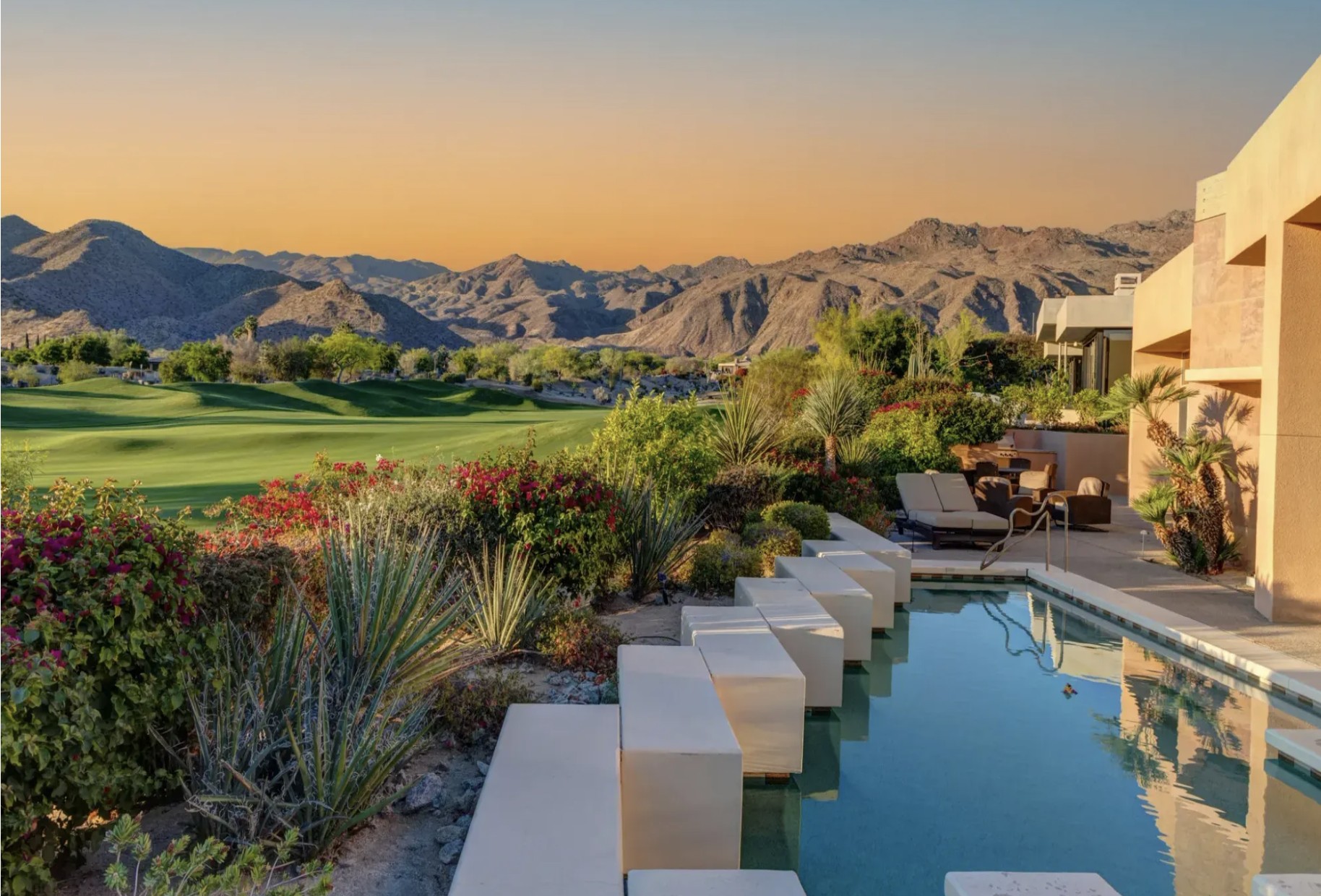
The community occupies the foothills above Palm Desert rather than the flat Valley floor, and the land continues to rise as you move into its higher residential pockets. The effect is not simply a better mountain view. At sufficient elevation the entire orientation of a property changes: fairways begin to sit below the house, the floor of the Coachella Valley opens in the distance, and city lights become part of the view after dark.
BIGHORN’s own description of its Summit Cove homesites makes the distinction unusually clear. One current homesite is described as elevated above the rest of the community, with views across golf, mountains and the lights of south Palm Desert.
That is why two houses of similar square footage can command very different values here. A lower golf front property may have a closer, greener relationship with the course, with fairway, water and mountain immediately outside the glass. A home higher into the foothills trades that intimacy for distance and scale. From the strongest elevated sites the view stops being one feature of the house and becomes the organising principle of the architecture.
Mountains and Canyons are not interchangeable
BIGHORN is effectively two distinct landscapes joined as one club, and the club itself separates property searches accordingly.
The Mountains Course, by Arthur Hills, was the original and makes particularly strong use of the property’s natural desert terrain and elevation changes. That side tends to give the classic BIGHORN relationship between architecture, exposed desert and golf. Depending on the homesite, residences can feel tucked into the mountain rather than placed beside a course.
The Canyons Course, by Tom Fazio, came later and occupies its own broad desert setting against the Santa Rosa Mountains. There are stretches where the land feels wider and the corridors more expansive, but it also contains some of BIGHORN’s highest residential positions. Summit Cove is the clearest example.
And within the Canyons the difference between sites can be substantial. A home on Rocky Creek has been marketed specifically around its elevated position and down Valley city light views. Mesquite Hills properties can have a much closer visual relationship with the Canyons Course and the mountains immediately behind them.
That distinction matters more than declaring one side better than the other. Ownership gives access to the same club. It does not give the same daily experience.
The premium is in the view corridor, not the street name
There are BIGHORN addresses that carry obvious recognition. Even within them, orientation decides the outcome. A buyer should be asking:
- Does the primary outdoor space look down Valley, across golf, into the Santa Rosa Mountains, or some combination?
- Is the house above the neighbouring rooflines or looking directly at them?
- Is the golf course experienced at eye level, below the property, or barely at all?
- Is the mountain a distant panorama, or does natural rock form the immediate backdrop?
- Does the pool terrace open toward afternoon sun, or does the mountain begin shading it earlier?
- And on elevated sites, how much of the city light view remains after dark?
Those are not cosmetic distinctions. At BIGHORN they are part of the value.
Elevation also changes the light
Because the community sits against the foothills, the afternoon is not the same as it is on the open Valley floor. The mountain mass to the west and southwest begins changing the quality of the light before sunset itself. Depending on orientation, a patio can move into softer light and shadow while the mountains and the Valley beyond remain lit.
For some buyers that is a feature. In season, a property that loses hard western sun earlier in the afternoon offers a very different outdoor life from one with a fully exposed west facing terrace.
But it does not reduce to higher is better. An elevated west facing home may produce extraordinary sunset and city light views while also taking more direct afternoon sun. A property sitting tighter against the mountain gains privacy and drama and loses some of the long Valley corridor. A golf front home lower down has less panorama and a far stronger connection to fairway, water and landscaping.
The best homesites solve more than one of those variables at once.
At BIGHORN, square footage establishes the category. The homesite establishes the hierarchy.
Which is why a 1998 home on a high, private site with an exceptional view corridor may be a more relevant comparable for a new residence than another 2008 home a few streets away with a fundamentally different orientation.
And here the two variables compound
Across the communities we cover, a pattern has emerged that is worth stating plainly.
| Toscana | Vintage dominates. Homes from 2014 onward carried a 33 percent premium per square foot over the 2004 to 2010 stock and sold in half the time, across 22 sales. |
| The Reserve | Position dominates. Every home that traded was built between 1999 and 2011, and the highest figure per square foot was achieved by the oldest of them. |
| BIGHORN | Both, and they compound. A 44 percent vintage premium, the widest we have measured, sitting on top of elevation differences that change the entire orientation of a property. |
That is why comparables here require unusually close attention to the land as well as the build year. Two variables moving together produce a wider spread than either alone, and a spreadsheet sorted by square footage will miss both.
Membership
This is the most important thing for a buyer to understand here, and it differs from most of the Valley.
Membership is available to property owners only, and club materials describe memberships as non equity, non voting and non transferable licences rather than an ownership stake. That is a different proposition from an equity club such as The Reserve, where resident golf membership is equity, or from Toscana, which offers non resident categories.
The questions worth asking before an offer: what happens to the membership on resale, whether an incoming buyer must apply afresh, whether membership can be resigned and on what terms, and whether capital assessments are possible.
Membership categories, initiation, dues, availability, transfer terms and assessment powers are set by the club, are subject to change without notice, and are not guaranteed by The McLennan Team or Desert Sotheby’s International Realty. Obtain written confirmation before making an offer.
Who BIGHORN is right for
Buyers who want elevation and a Valley outlook rather than a fairway view, and who value being three miles from El Paseo rather than twenty minutes from anywhere.
It suits serious golfers, given two courses and the highest slope rating in the communities we cover. And it suits collectors, because The Vault is a genuinely unusual amenity and BIGHORN is one of only two places in the Valley built with a collection in mind.
It is less suited to buyers who want an equity stake in their club, or who want the reassurance that membership transfers cleanly with the house. Those buyers should look carefully at the terms before committing.
How BIGHORN compares
| BIGHORN | Toscana | The Reserve | |
|---|---|---|---|
| City | Palm Desert | Indian Wells | Indian Wells and Palm Desert |
| Setting | Santa Rosa foothills, elevated above the Valley | Valley floor, formally master planned | 780 acres built into the slope |
| Golf | Two courses, Arthur Hills and Tom Fazio | Two Nicklaus Signature courses | 21 holes, Weiskopf and Morrish |
| Membership | Owners only. Non equity, non voting, non transferable | Resident and non resident categories | Resident golf is equity, owners only. Capped at 250 |
| Median closed price | $5,700,000 | $4,025,000 | $3,082,500 |
| Median price per sq ft | $1,056 | $897 | $881 |
| Months of supply | About 2.8 | About 1.4 | About 6 |
All figures retrieved August 4, 2026.
Read the full guides: The Madison Club · The Hideaway · Tradition Golf Club · PGA WEST · The Quarry · Andalusia · Toscana · The Reserve · The Thermal Club · all community guides
Frequently asked questions
Do you have to own a home at BIGHORN to be a member?
Yes. Membership is available to property owners only, and club materials describe memberships as non equity, non voting and non transferable licences rather than an ownership stake in the club. That is a materially different structure from an equity club and should be understood before purchase. Confirm current categories and terms directly with the club.
What do homes cost at BIGHORN?
Over the six months to August 4, 2026, 13 homes closed between $2,975,000 and $14,500,000, with a median closed price of $5,700,000 and a median of $1,056 per square foot. That is the highest median price per square foot of any community we track. As of that date there were six active listings asking between $2,395,000 and $7,950,000.
What golf is there?
Two courses. The Mountains course, designed by Arthur Hills and opened in 1991, plays 6,874 yards to a slope of 143. The Canyons course, designed by Tom Fazio and opened in 1998, plays 7,043 yards to a slope of 141. The two are linked by a cart tunnel beneath Highway 74.
What is The Vault?
An auto gallery within the club where members display and store collections. Around ninety members participate. It is unusual among Valley golf clubs and it draws a particular kind of member, one who would also recognise the appeal of a private motorsport community elsewhere in the Valley.
How large are the homes and homesites?
Recent sales ranged from 3,314 to 10,525 square feet on homesites of roughly 0.29 to 0.83 acres. The community was planned for around 570 homes at completion, and the land is held fee simple.
Why do so many homes sell at full asking?
Four of the thirteen sales in the period closed at full asking price or above, and three of those sold with zero days on market. That means they transacted before or immediately upon listing, which is characteristic of a community where a meaningful share of activity happens through relationships rather than through the MLS.
How does BIGHORN compare to the Indian Wells clubs?
BIGHORN sits in the Santa Rosa foothills above Palm Desert, three miles up Highway 74 from El Paseo, which gives it elevation and proximity to shopping and dining that the Indian Wells clubs do not have. It carries two courses like Toscana, but membership is restricted to property owners and is non equity, where Toscana offers resident and non resident categories and The Reserve's resident golf membership is equity. Median pricing at BIGHORN is also higher than either.
Buying or selling at BIGHORN
Three of thirteen recent sales here closed at full asking with zero days on market. That is not a market a buyer navigates from a search page, and it is not one a seller should approach without understanding what comparable homes at similar elevation and vintage have actually achieved.
Laurie McLennan has spent decades advising buyers and sellers throughout the Coachella Valley, including clients evaluating the Palm Desert and Indian Wells private clubs. Three generations of Realtors sit behind that experience, and a desert connection dating to 1960.
Last updated: August 4, 2026
Written by Laurie McLennan, Founder, The McLennan Team at Desert Sotheby’s International Realty
California DRE #01424382 · Market figures from GPS MLS and CRMLS, retrieved August 4, 2026
Club membership terms, fees, dues, transfer provisions and rules are set by BIGHORN Golf Club. Short term rental regulations are set by the City of Palm Desert and by the community’s governing documents. All are subject to change without notice, are not guaranteed by The McLennan Team or Desert Sotheby’s International Realty, and should be confirmed in writing before any purchase decision. This page is informational and is not legal, financial or tax advice.