


Community guide · La Quinta
The Hideaway homes for sale: a buyer’s guide.
Quick answer
The Hideaway is a private golf and residential community in La Quinta, California, developed by Discovery Land Company across approximately 600 acres. It has two 18 hole courses, one designed by Pete Dye and one by Clive Clark, giving members considerably more on property golf variety than many of La Quinta’s single course private communities. The community has 434 residences and caps private equity golf membership at 450, and its roughly 80,000 square foot clubhouse makes it noticeably more social and family oriented than the Valley’s quieter private communities. Inventory is unusually thin. Over the six months to July 31, 2026, fourteen homes sold from $3.65 million to $11.3 million, with a median closed price of $5,675,000, against a single active listing. Membership should be evaluated separately from the real estate purchase.
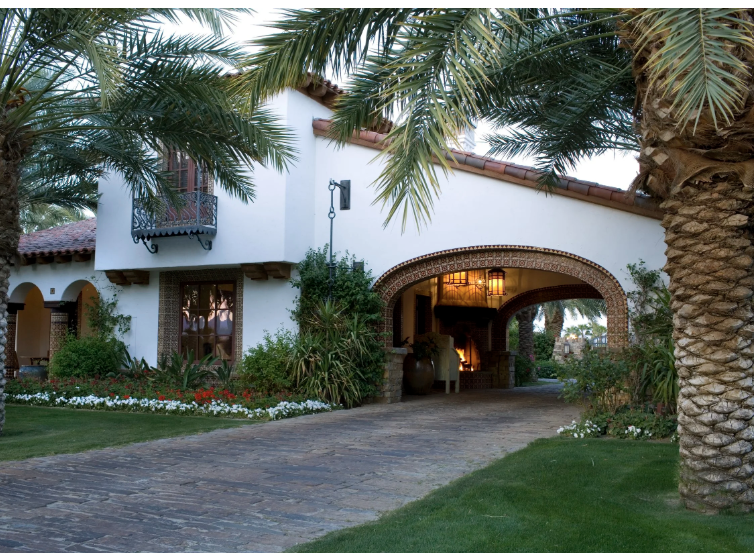
The Hideaway at a glance
| Location | La Quinta, Coachella Valley, California |
| Community type | Private golf and residential community |
| Developer | Discovery Land Company |
| Community size | Approximately 600 acres |
| Residences | 434, from clubhouse adjacent bungalows and golf villas to individually designed custom estates |
| Golf | Two private 18 hole, par 72 courses, designed by Pete Dye and Clive Clark |
| Membership cap | 225 private equity golf members per 18 holes, 450 in total |
| Homesites | Vary considerably by location; many custom estate properties are approximately one third acre and larger |
| Home sizes | Broad range; many luxury residences are approximately 4,500 to 7,000+ sq ft, with larger custom estates available |
| Recent closed sales | $3,650,000 to $11,300,000, median $5,675,000, six months to July 31, 2026* |
| Architecture | Primarily custom desert architecture, from traditional and transitional homes to newer contemporary designs |
| Gated and staffed | Yes |
| Clubhouse | Approximately 80,000 sq ft |
| Club amenities | 36 holes of private golf, clubhouse dining and social spaces, fitness and wellness, pool and sport courts |
| Palm Springs International | Approximately 30 minutes by car, traffic dependent |
*Closed sale figures cover January 31 to July 31, 2026 and are a snapshot rather than a valuation guide. Home and homesite sizes vary considerably and are given as approximate ranges rather than community parameters.
What makes The Hideaway different
Two championship courses is the obvious answer, and it is a meaningful one. The Hideaway has an 18 hole Pete Dye course and an 18 hole Clive Clark course, giving members two distinctly different golf experiences within the same community. The Dye course is the more visually dramatic and strategic of the two, while the Clark course has broader fairways, significant water features and a somewhat more flowing character.
The part buyers sometimes miss is what 36 holes does to the rhythm of the club. The Hideaway limits private equity golf membership to 225 members per 18 holes. That means the second course is not simply another amenity on a brochure. It creates more variety in how members play, spreads golfers across two courses and gives the club considerably more flexibility than a single course community.
The less obvious difference is social. The Hideaway describes itself today as a family friendly, social, member owned club, and that distinction matters. It has 434 residences and a membership capped at 450, along with an approximately 80,000 square foot clubhouse, spa, fitness center, resort style pool and sport courts.
In practice, that creates a community where the club tends to be part of the day rather than simply the place you go to play golf. A Saturday can move from an early tee time to lunch at the clubhouse, children or grandchildren at the pool, an afternoon workout or spa appointment and dinner with friends without ever leaving the gates. For buyers who want their desert home to come with a built in social ecosystem, that is one of The Hideaway’s strongest appeals.
That also makes The Hideaway different from some of La Quinta’s quieter, more residentially focused private communities. Privacy is still very much part of the experience, but The Hideaway is generally better suited to someone who wants to participate in the club, not simply live alongside a beautiful golf course.
By late Saturday morning in season, The Key is the kind of place where the different parts of Hideaway life begin to overlap: golfers finishing the front nine on the Clive Clark course, families settling in by the pool, and friends meeting for a casual lunch before deciding whether the afternoon means another nine, a spa appointment or simply staying put. That crossover between golf, family and social life is a good example of what makes The Hideaway feel less like a club you visit and more like a community you actually use.
Architecture, homesites and orientation
One of the reasons The Hideaway requires more explanation than its price range suggests is that the real estate is not particularly uniform. The community contains 434 residences ranging from clubhouse adjacent bungalows and golf villas to individually designed custom estates and larger homesites, so two properties here can deliver substantially different ownership experiences even when their asking prices are similar.
That is why buyers should be careful about evaluating a Hideaway home primarily on square footage. A smaller residence with the right orientation, mountain framing and relationship to the golf course can be considerably more compelling than a larger home on a less desirable site.
Orientation matters enormously here
In La Quinta, orientation determines much more than the photograph from the backyard. A south or southwest facing property can deliver dramatic Santa Rosa Mountain views, but exposure to afternoon sun becomes an important practical consideration, particularly during the shoulder months. Northern orientations can provide softer afternoon exposure, but the mountain presentation may be different.
Golf course frontage can create tremendous openness, yet there is a meaningful distinction between looking down a fairway, looking across a fairway, sitting near a green or tee box, and having cart traffic immediately behind the property. Those details affect privacy, noise, sunlight and ultimately how the outdoor spaces actually feel. This is one of the areas where walking the property at the right time of day matters more than studying the listing photographs.
Dye versus Clark
Both courses are par 72. The Pete Dye course is intentionally more dramatic, with lakes, waterfalls, strategic bunkering and the visual tension associated with Dye’s architecture. It recently underwent a greens restoration and bunker upgrade led by architect Tim Liddy, including the addition of Spectacle style bunkers. The Clive Clark course presents differently. Its gently rolling fairways play toward larger greens, with waterfalls, water features, desert landscaping and mountain views creating a more expansive experience. The Hideaway’s golf villas are positioned along the Clark fairways.
For a homebuyer, however, neither course is universally more desirable. The better lot wins. A beautifully oriented Clark course property with a long mountain view may be far more desirable than a Dye course property with compromised afternoon exposure or privacy, and the reverse is equally true.
Proximity to the clubhouse
Being relatively close to the clubhouse can be extremely attractive for owners who intend to use the club frequently. At approximately 80,000 square feet it functions as much more than a golf clubhouse, with dining, fitness, spa, pool and social facilities.
But closest to the clubhouse should not automatically mean best. Some buyers will gladly trade a few additional minutes by golf cart for greater separation, a stronger mountain corridor or a quieter homesite. For a family using the house throughout the season, convenience may win. For someone purchasing primarily as a private retreat, orientation and separation may matter more.
The pockets that are hard to replicate
Certain homesites along Via Dona are particularly difficult to replicate. On the Clive Clark course, select properties combine long, double fairway sightlines with dramatic western views toward the Santa Rosa and San Jacinto mountains. The best positioned lots can also avoid a cart path immediately behind the home, which makes a meaningful difference in privacy. Inventory with that combination of orientation, golf frontage and mountain exposure is limited, so buyers waiting for it may need to be patient.
Membership
Membership should be evaluated separately from the purchase of the real estate. Private equity golf membership is capped at 225 members per 18 holes, or 450 in total, against 434 residences. That ratio is worth understanding, because it is the reason the club can support two courses without either feeling crowded.
Prospective buyers should confirm current membership availability, requirements and dues directly with the club as part of their due diligence, particularly on a resale property.
Current market snapshot
As of July 31, 2026, for the MLS subdivision The Hideaway within La Quinta Area 313:
| Active listings | 1, asking $6,499,000 |
| Under contract or pending | 2 |
| Closed sales, six months | 14 |
| Closed price range | $3,650,000 to $11,300,000 |
| Median closed price | $5,675,000 |
| Median closed price per sq ft | $1,237 |
| Closed home sizes | 2,756 to 8,410 sq ft |
| Median sale to list ratio | 96% |
| Median days on market | 27 |
The headline here is scarcity. Fourteen homes sold in six months against a single active listing, which is roughly two weeks of supply at the current pace. Buyers who want a specific orientation, course frontage or street are frequently waiting rather than choosing.
The other number worth reading is the pace. The median home went under contract in 27 days at 96 percent of asking, and one sold above list. That is a materially faster and firmer market than the Valley’s most rarefied communities, where inventory sits longer and the gap between asking and achieved prices is wider. A well positioned Hideaway home does not tend to linger.
Within the closed sales, Via Dona accounted for four of the fourteen transactions, more than any other street.
Source: GPS MLS and CRMLS, subdivision The Hideaway, La Quinta Area 313, retrieved July 31, 2026. Closed sales cover January 31 to July 31, 2026. Information is deemed reliable but is not guaranteed. Updated monthly.
Who The Hideaway is right for
The Hideaway suits buyers who want exceptional golf alongside a more active, social and family oriented club environment. Two courses matter to people who actually play often, and the broader residential character appeals to owners who want a community rather than a retreat. It is generally better suited to someone who wants to participate in the club rather than simply live alongside a beautiful golf course.
How The Hideaway compares
The Hideaway and The Madison Club were both developed by Discovery Land Company and are frequently compared. The differences are less about quality than about the kind of life each one is built around.
| The Hideaway | The Madison Club | Tradition Golf Club | |
|---|---|---|---|
| Developer and origins | Discovery Land Company | Discovery Land Company | Sienna Corporation with Arnold Palmer; member owned since 2008 |
| Character | Social, family oriented luxury club with a broader residential feel | Ultra private, resort like, contemporary and highly curated | Intimate, understated and rooted in Arnold Palmer’s legacy |
| Golf | 36 holes: Pete Dye and Clive Clark | One 18 hole course, Tom Fazio | One 18 hole championship course, Arnold Palmer, plus a 9 hole par 3 |
| Homesites | Vary considerably; many custom estate properties approximately one third acre and larger | Approximately 0.50 to 1.5 acres | Custom estates and cottages; many approximately one third to one half acre |
| Home price range | Recent closed sales $3.65M to $11.3M, median $5.675M | Approximately $12M to $85M | Approximately $3.4M to $9M |
| Best suited to | Buyers who want exceptional golf alongside a more active, social and family oriented club environment | Buyers prioritizing maximum privacy, service, trophy real estate and a resort style ownership experience | Buyers drawn to an intimate club culture, classic desert architecture, serious golf and a strong sense of history |
Hideaway figures are closed sales for the six months to July 31, 2026. Madison and Tradition figures are asking price ranges for publicly marketed inventory as of July 2026. All change as properties enter and leave the market.
Read the full guides: The Madison Club · Tradition Golf Club · PGA WEST · The Quarry · Andalusia · all community guides
Frequently asked questions
Do you have to be a member to buy a home in The Hideaway?
Ownership and club membership at The Hideaway are closely connected, but buyers should not assume that membership is automatically included with the purchase of a home. Real estate ownership and club membership are handled as separate components. Private equity golf membership is capped at 225 members per 18 holes, or 450 in total. A prospective buyer should confirm the current membership requirement, application process, availability and fees directly with The Hideaway before purchasing, particularly when considering a resale property.
How much are Hideaway dues and initiation?
The Hideaway does not publish membership figures publicly. Prospective buyers should confirm current membership availability, initiation requirements and dues directly with the club as part of their due diligence.
What do homes cost in The Hideaway?
Inventory is unusually thin. As of July 31, 2026 there was a single active listing in The Hideaway, asking $6,499,000, with two more under contract or pending. Closed sales are the better guide. Over the six months to July 31, 2026, fourteen homes sold from $3,650,000 to $11,300,000, with a median closed price of $5,675,000 and a median of $1,237 per square foot. Those numbers are more useful as a starting point than as a valuation formula. The Hideaway contains everything from clubhouse adjacent bungalows and golf villas to individually designed custom estates, and pricing can change substantially based on homesite, orientation, mountain exposure, course frontage, privacy, renovation quality and furnishings. A smaller home on an exceptional lot can command more than a larger residence in a less desirable position.
What is the difference between the Pete Dye and Clive Clark courses?
The Hideaway has two private 18 hole, par 72 courses, but they do not play or present the same way. The Pete Dye course is the more strategic and visually demanding of the two. Rolling fairways are framed by native grasses, sand, streams and ponds, with water and bunkering frequently influencing how a player approaches the green. It completed a major restoration led by Tim Liddy, including restored greens and upgraded bunkering, so it retains the unmistakable Dye emphasis on angles, positioning and decision making. The Clive Clark course feels broader and more flowing. Its gently rolling fairways play toward larger greens, with waterfalls, water features, desert landscaping and mountain views creating a more expansive visual experience. It is still challenging, but generally rewards creativity and shot making differently from the more exacting Dye layout. For a buyer the distinction matters beyond golf. The Hideaway's golf villas are positioned along the Clive Clark fairways, and some Clark course properties benefit from broad fairway corridors and direct southern views toward the Santa Rosa Mountains. Custom residences and homesites occur throughout the community, so the better question is not Dye or Clark, but what this particular lot looks at and how it lives.
How many homes are there in The Hideaway?
The Hideaway has 434 residences, ranging from bungalows and golf villas to individually designed custom estates, across approximately 600 acres. Private equity golf membership is capped at 450.
Are short term rentals allowed in The Hideaway?
A buyer should not assume that a new short term vacation rental permit can be obtained in The Hideaway. The City of La Quinta has maintained a permanent ban on most new short term vacation rental permits since May 20, 2021. New permits are generally limited to specifically exempt areas, qualifying homeshare permits and certain large lot properties, and the City's current published list of exempt areas does not include The Hideaway. Existing properties with properly maintained permits may be treated differently under City rules, and certain qualifying properties can fall under separate exceptions. The Hideaway's own HOA, club and governing documents may also impose restrictions more stringent than City requirements. If rental ability is important to the purchase, verify the specific property address, existing permit status and current HOA documents before relying on rental income or rental use as part of the decision. Full detail on the City ordinance, the exempt developments and the two exemption routes is on our page covering short term rental eligibility in La Quinta.
How does The Hideaway compare to The Madison Club?
Both are Discovery Land Company communities in La Quinta, but the difference is less about quality than about the kind of life each is built around. The Madison Club is the more rarefied experience: highly private, highly curated, contemporary in character and concentrated at the very top of the desert market. Homesites and estates tend to be larger, and the overall experience places an unusual emphasis on privacy, discretion and personalized service. The Hideaway feels broader and more social. It occupies approximately 600 acres, offers two championship courses rather than one, and describes itself today as a social oriented, family friendly, member owned club designed to be used. Madison tends to appeal to the buyer who wants maximum privacy and a highly curated retreat. The Hideaway tends to appeal to the buyer who wants privacy but also wants a genuine club community around them.
How does The Hideaway compare to The Citrus?
The simplest distinction is that The Hideaway is more club centered and The Citrus is more residentially flexible. At The Hideaway the club is a major part of the ownership experience, so buyers are often choosing the community and the club at the same time. The Citrus generally offers a quieter residential rhythm and a broader range of ways to use a desert home. For a buyer who wants an active social calendar and expects the club to organize a meaningful part of life in La Quinta, The Hideaway usually has the advantage. For someone who wants a beautiful gated community but prefers club participation to remain more optional, The Citrus can be the better fit.
Buying or selling in The Hideaway
Laurie McLennan has spent decades advising buyers and sellers throughout La Quinta and the Coachella Valley, including clients evaluating the desert’s most private golf and residential communities. Three generations of Realtors sit behind that experience, and a desert connection dating to 1960.
Last updated: July 31, 2026
Written by Laurie McLennan, Founder, The McLennan Team at Desert Sotheby’s International Realty
California DRE #01424382 · Board of Regents, Who’s Who in Luxury Real Estate