


Community guide · La Quinta
Tradition Golf Club homes for sale: a buyer’s guide.
Quick answer
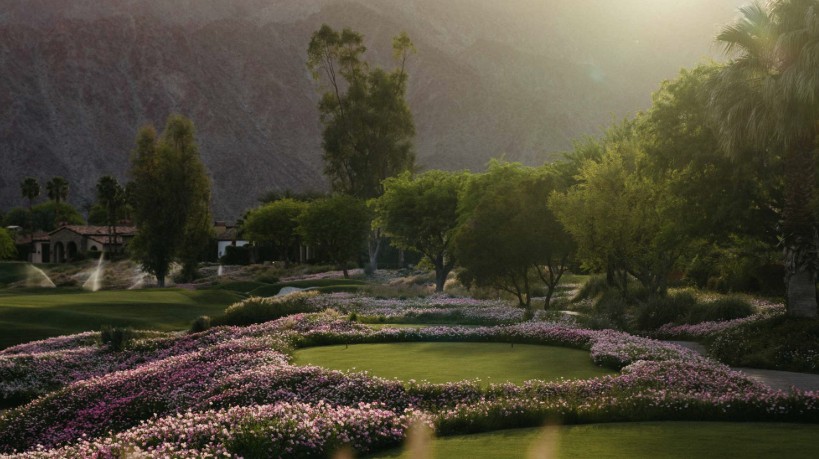
Tradition Golf Club is a private, member owned equity golf club and residential community in La Quinta, California, set in a cove at the base of the Santa Rosa Mountains. Arnold Palmer personally selected the site and designed both the 18 hole championship course and the 9 hole par 3 course, and Tradition was his only desert home. The community is built around a homestead dating to 1902, including Hacienda del Gato, the oldest structure in La Quinta. Two things distinguish Tradition from the Valley’s other private clubs: it is member owned rather than developer or operator owned, and the club states that residency is not a requirement for membership. It is smaller, quieter and more historically rooted than most of its peers.
Tradition at a glance
| Location | La Quinta, Coachella Valley, California |
| Community type | Private, member owned equity golf club |
| Origins | Homesteaded 1902 by John Marshall; developed by Sienna Corporation with Arnold Palmer |
| Course opened | 1997 |
| Ownership | Transitioned from developer owned to member owned equity club |
| Golf | 18 hole par 72 championship course and 9 hole par 3, designed by Arnold Palmer with Ed Seay |
| Signature hole | Par 4 17th, elevated tee dropping more than 200 feet to the fairway |
| Setting | A private cove at the base of the Santa Rosa Mountains, with significant elevation change |
| Residences | Custom estates and cottages |
| Homesites | Approximately one quarter acre to one acre; buildable lots still available |
| Architecture | Spanish Colonial, Spanish Revival and Early California, with Mediterranean and contemporary residences |
| Membership | Residency not required |
| Recognition | Platinum Club of America; ranked among America’s top golf communities by Travel + Leisure |
| Palm Springs International | Approximately 20 minutes by car, traffic dependent |
What makes Tradition different
Most private clubs in the Valley were built as real estate ventures with a golf course attached. Tradition was built the other way round, on land with a century of recorded history, by a man who intended to live there.
Arnold Palmer chose the site himself and designed every hole. It was the only desert home he ever owned, and his cottage and Winnie’s pool are still part of the property. In 2018 the club unveiled a bronze statue of Palmer, one of only three authorized by his family. The other two are at Wake Forest, his alma mater, and Bay Hill in Florida. That is the company Tradition keeps in the Palmer story, and it is not a marketing claim the club invented.
The land matters as much as the golf. The property was homesteaded in 1902 by John Marshall, who went on to build the La Quinta Resort. His ranch house, Hacienda del Gato, still stands and is the oldest structure in La Quinta. La Quinta Cove was once Marshall Cove, and Washington Street, the road that brings you to the gate, was originally Marshall Road.
The Hacienda became a retreat for Hollywood long before it became a golf club. Katharine Hepburn and Clark Gable stayed there, and Presidents Eisenhower and Kennedy both visited for extended stays. Very few communities in the desert can point to that kind of continuity, and Tradition is one of the few that has kept the original buildings rather than clearing them.
The third difference is structural and it matters more to buyers than the history does. Tradition is a member owned equity club, which means members collectively own it rather than a developer or an operating company. And the club states that residency is not a requirement for membership. Both facts change how a purchase here works compared with the Discovery Land communities down the road.
Architecture, homesites and orientation
The developers chose to build in tribute to the original Hacienda del Gato rather than against it, so Tradition reads as Spanish Colonial, Spanish Revival and Early California, with Mediterranean influences and a number of newer contemporary residences alongside them. Courtyards, fountains and hand hewn beams are common. That is a deliberate contrast with the newer Discovery Land communities, where contemporary desert architecture dominates.
Homesites vary considerably, running from roughly a quarter acre to a full acre, with buildable lots still available through the club’s on site sales office. That range matters: a quarter acre and a full acre in the same community are different propositions entirely.
Elevation is the differentiator here
Most of the Valley’s private communities sit on flat ground. Tradition does not. It was built into a cove at the base of the Santa Rosas, and the elevation change across the property is real enough that the signature par 4 17th plays from a tee dropping more than 200 feet to the fairway below. That topography is the single biggest driver of value here, and it is the thing least visible in listing photographs.
The positions worth understanding
Tradition is small enough that buyers sometimes assume location within the gates matters less than it does. In practice, the character of a home changes considerably depending on whether it sits above the community, against the mountain edge, or closer to the golf and clubhouse.
At the upper end of Del Gato Drive, elevation becomes the amenity. The strongest positions look out over the community rather than simply across a single fairway, with long cross valley sightlines, mountains in more than one direction and, in some cases, natural rock immediately around the homesite. This is where Tradition feels most expansive. The trade off is distance from the clubhouse and a setting in which the golf may become part of the broader landscape rather than the immediate backyard.
The Talking Rock and Coyote Canyon side of the back nine offers a very different experience. Here the appeal is not elevation so much as immersion. Palmer routed the closing holes tightly against the Santa Rosa Mountains, and the best homesites in this part of the community combine golf, ravine, rock and natural desert in the same frame. The mountain wall feels much closer here than it does from the elevated sites above the community.
If Del Gato is about looking out over Tradition, Coyote Canyon is about feeling tucked into it.
Closer to the front of the property, south facing positions around Deacon Drive and Claret Cove deliver the more classic La Quinta view: green fairway in the foreground with the Santa Rosa Mountains rising behind it. These homes do not have the dramatic elevation of upper Del Gato or the raw mountain edge of the back nine, but they can offer something many buyers ultimately value more, which is strong golf and mountain views together with easier access to the clubhouse, dining and first tee.
Close to the clubhouse is not automatically better
Proximity should not be treated as either a premium or a compromise. For an owner who expects to use the club several times a week, being able to walk or take a very short cart ride to dinner, golf or the Hacienda can matter more than maximum separation. For another buyer the same position means giving up privacy from club activity.
Arnold Palmer’s own choice is instructive. He built here in 1999 and hand selected his site: on the second fairway of the short course, within easy walking distance of the clubhouse, with southern mountain and fairway views. He did not take the highest homesite available.
That is worth weighing, because at Tradition the choice is rarely golf view against mountain view. It is more often club convenience against elevation, fairway activity against privacy, and looking across the Valley against feeling enclosed by the mountains.
The mountain corridors are not all the same
The phrase mountain view is particularly unhelpful here, because nearly every part of the community has mountains somewhere in the sightline. What changes is the relationship to them.
On upper Del Gato, the mountains frame a much larger panorama across the Valley. Along Coyote Canyon and the back nine, they become immediate and architectural, with natural rock and desert forming part of the property setting. On the south facing front nine, they sit beyond manicured golf and create the classic desert composition many buyers first imagine when they come to La Quinta.
None is inherently better. They appeal to different buyers. If we were orienting someone to Tradition before comparing individual houses, we would want them to understand all three settings first: upper Del Gato for elevation and cross valley perspective, Talking Rock and Coyote Canyon for mountain edge drama, and the south facing Deacon and Claret positions for golf, mountains and proximity to the club. Only after deciding which of those feels right does it make sense to start comparing floor plans, finishes and price per square foot.
At Tradition the premium is not simply having a mountain view. Nearly everyone has one.
The real question is whether you want to look out over the landscape, feel enclosed by the mountains, or look across golf toward them.
Membership
Tradition is a member owned equity club, and the club states that residency is not a requirement for membership. That is a meaningful distinction from the Valley’s residence based clubs, and it cuts both ways for a buyer. It means you are not obliged to buy a home in order to join, and it also means owning a home does not automatically carry membership with it.
Confirm current membership availability, requirements and fees directly with the club as part of due diligence, particularly on a resale property.
Current market snapshot
As of July 31, 2026, for the MLS subdivision Tradition Golf Club within La Quinta Area 313:
| Active listings | 4 |
| Pending | 1 |
| Active asking range | $3,995,000 to $6,500,000 |
| Median active asking price | $5,185,000 |
| Active price per sq ft | $909 to $1,219 |
| Closed sales, six months | 4 |
| Closed price range | $4,500,000 to $7,675,000 |
| Median closed price | $5,825,000 |
| Median closed price per sq ft | $947 |
| Closed home sizes | 4,760 to 7,063 sq ft |
| Median sale to list ratio | 96% |
| Median days on market | 103 |
Tradition sits between its neighbours in pace. Four sales in six months against four active listings is roughly six months of supply, which is slower than The Hideaway and more measured than The Madison Club, but pricing has held firm: the median sale closed at 96 percent of asking and the range across the four was narrow, from 94 to 97 percent.
The more interesting number is the spread in price per square foot. Three of the four closed sales landed within twelve dollars of one another, between $936 and $949. The fourth closed at $1,383, roughly 46 percent above the next highest.
That sale was a new build in an elevated position on upper Del Gato Drive. New construction carries a premium anywhere, so the two factors cannot be fully separated, but the gap is large enough to be worth noting. It is the clearest evidence in the data that at Tradition the site does much of the work, and that a home’s position in the cove is not a secondary consideration to its square footage.
By contrast, the largest home to trade in the period, just over 7,000 square feet on Talking Rock Turn against the mountain edge, sold at $949 per square foot. A bigger house, a strong setting, and a price per foot in line with the community norm. Scale and position are priced quite differently here.
Source: GPS MLS and CRMLS, subdivision Tradition Golf Club, La Quinta Area 313, retrieved July 31, 2026. Closed sales cover January 31 to July 31, 2026. Information is deemed reliable but is not guaranteed. Updated monthly.
Who Tradition is right for
Tradition suits buyers drawn to an intimate club culture, serious golf and a genuine sense of history rather than scale or spectacle. It tends to appeal to people who want the club to feel like a private world rather than a resort, and who value a course designed and played by its namesake over newer architecture.
The member owned structure appeals to buyers who want a say in how the club is run. It also means the club’s direction is set by its membership rather than by an operator, which is a different proposition from a Discovery Land community and worth understanding before joining.
How Tradition compares
| Tradition Golf Club | The Madison Club | The Hideaway | |
|---|---|---|---|
| Ownership | Member owned equity club | Discovery Land Company | Discovery Land Company |
| Character | Intimate, understated and rooted in Arnold Palmer’s legacy | Ultra private, resort like, contemporary and highly curated | Social, family oriented luxury club with a broader residential feel |
| Golf | 18 hole championship plus 9 hole par 3, Arnold Palmer | One 18 hole course, Tom Fazio | 36 holes: Pete Dye and Clive Clark |
| Membership and residency | Residency not required for membership | Residence based club model | Residence based club model |
| Homesites | Approximately one quarter acre to one acre | Approximately 0.50 to 1.5 acres | Vary considerably; many approximately one third acre and larger |
| Price range | Recent closed sales $4.5M to $7.675M, median $5.825M | Approximately $12M to $85M | Recent closed sales $3.65M to $11.3M, median $5.675M |
Read the full guides: The Madison Club · The Hideaway · PGA WEST · The Quarry · Andalusia · all community guides
Frequently asked questions
Do you have to own a home at Tradition to be a member?
No. Tradition Golf Club states that residency is not a requirement for membership, which distinguishes it from communities where the two are more tightly linked. Buyers should still confirm current membership availability, requirements and fees directly with the club as part of due diligence.
Is Tradition member owned?
Yes. Tradition began as a developer owned club and formally transitioned to a member owned equity club. That structure means members collectively own the club rather than a developer or an operating company, which affects how decisions about the course, the clubhouse and capital projects get made.
Who designed the golf course?
Arnold Palmer personally chose the location and designed each hole, working with his longtime design partner Ed Seay. The 18 hole par 72 championship course opened in 1997 and features wide fairways, water hazards, white sand bunkers and fast greens. There is also a 9 hole par 3 short course. The signature hole is the par 4 17th, which plays from an elevated tee that drops more than 200 feet to the fairway below.
What is the history of the property?
The land was homesteaded in 1902 by John Marshall, who later built the La Quinta Resort. His ranch house, Hacienda del Gato, is the oldest structure in La Quinta and still stands within the community. Long before it became a golf club the Hacienda was a retreat for Hollywood, with Katharine Hepburn and Clark Gable among its guests, and Presidents Eisenhower and Kennedy both visited for extended stays. La Quinta Cove was once known as Marshall Cove, and Washington Street, the road that leads into Tradition, was originally Marshall Road.
Did Arnold Palmer live at Tradition?
Yes. Tradition was Palmer's only desert home, and his cottage and Winnie's pool remain part of the property. A bronze statue of Palmer, one of only three authorized by the Palmer family, was unveiled at Tradition in 2018. The others are at Wake Forest University and Bay Hill Club in Florida.
What do homes cost at Tradition?
As of July 31, 2026 there were four active listings asking between $3,995,000 and $6,500,000, with a median asking price of $5,185,000. Over the six months to July 31, 2026, four homes closed between $4,500,000 and $7,675,000, with a median closed price of $5,825,000 and a median of $947 per square foot. The median sale closed at 96 percent of asking after a median 103 days on market. Price per square foot is a poor guide on its own here. Three of the four closed sales fell within a narrow band around $940, while a new build in an elevated position on upper Del Gato Drive closed at $1,383, roughly 46 percent higher. At Tradition, elevation, orientation and proximity to the clubhouse move value more than size does.
Are short term rentals allowed at Tradition?
A buyer should not assume a new short term vacation rental permit can be obtained. Under Ordinance 591, effective May 20, 2021, the City of La Quinta imposed a permanent ban on the issuance of new short term vacation rental permits, with new permits available only to properties in specifically exempt areas. Since January 4, 2024 two further routes exist. Homeshare permits, which require the owner to occupy the property throughout the guest stay. And Large Lot Qualified and Certified properties, meaning a single parcel of 25,000 square feet or more, which may apply for an exemption subject to criteria and a public hearing. That second route is worth noting at Tradition, because 25,000 square feet is roughly 0.57 acres. Most Tradition homesites fall below that threshold, but the larger estate parcels can exceed it, so eligibility genuinely varies by address. Tradition’s own governing documents may also be more restrictive than City rules. The City recommends verifying a specific address with its Short Term Vacation Rental team before relying on rental use, and any purchase decision that depends on rental income should treat eligibility as property specific due diligence. Full detail on the City ordinance, the exempt developments and the two exemption routes is on our page covering short term rental eligibility in La Quinta.
How does Tradition compare to The Madison Club and The Hideaway?
Madison and The Hideaway were both developed by Discovery Land Company and operate on a residence based club model. Tradition is member owned, does not require residency for membership, and is smaller in scale and quieter in character. Where Madison emphasizes privacy and service and The Hideaway emphasizes social and family life, Tradition is built around golf history and an understated club culture.
Buying or selling here
Laurie McLennan has spent decades advising buyers and sellers throughout La Quinta and the Coachella Valley, including clients evaluating the desert’s most private golf and residential communities. Three generations of Realtors sit behind that experience, and a desert connection dating to 1960.
Last updated: July 31, 2026
Written by Laurie McLennan, Founder, The McLennan Team at Desert Sotheby’s International Realty
California DRE #01424382 · Board of Regents, Who’s Who in Luxury Real Estate